
Why guidelines include it
U.S. and WHO guidelines for older adults include balance training alongside aerobic and strength activity. WHO describes the aim as supporting everyday function and lowering the risk of falls.
That is a statement about what is advised for older adults in general. It is not a promise about any one person.
Before you start
- If you have fallen, feel unsteady, get dizzy, or have numbness in your feet, talk with a clinician or physical therapist first.
- Practice only where you can grab something sturdy with either hand: a kitchen counter is ideal.
- Clear the floor, wear stable shoes or go barefoot on a non-slip surface, and have someone nearby if you can.
A first practice
The step below is the same one Fit after 50 members can be given. It takes about five minutes and always keeps support within reach.
Practice five minutes of supported balance
About 5 minutes · Easy. Keep a hand on the counter the whole time.
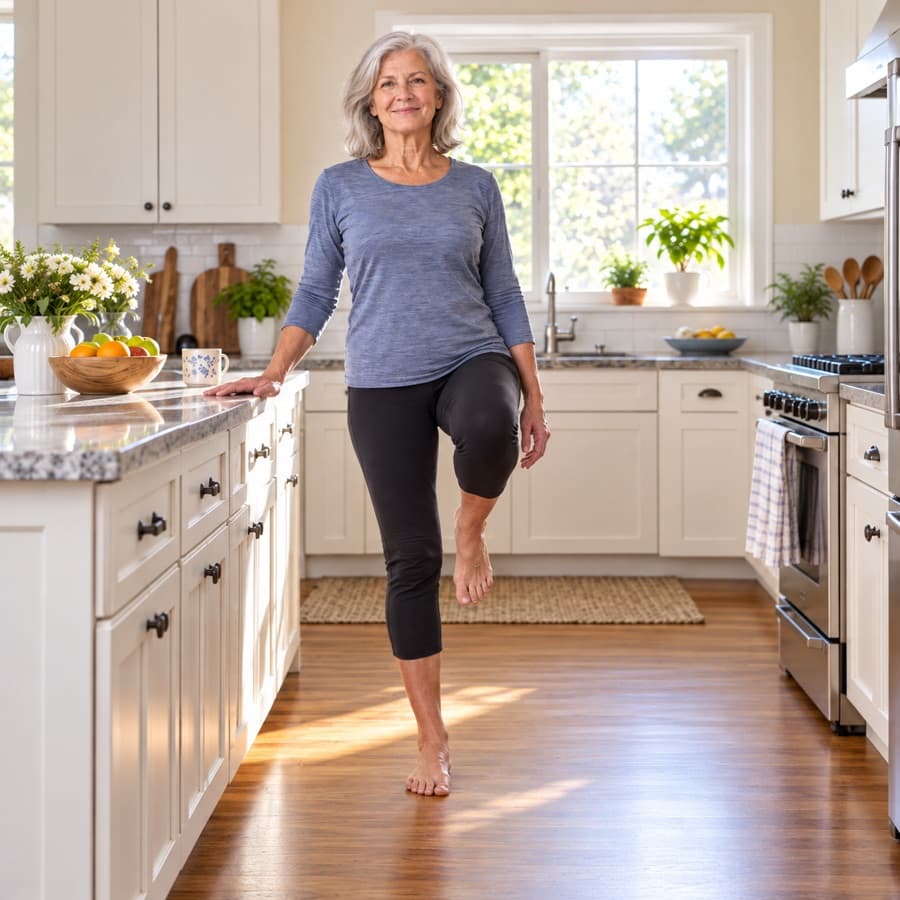
Stand beside a stable counter or chair and practice comfortable weight shifts with support within reach.
- You will need
- A stable kitchen counter or sturdy chair to hold, and a clear floor.
- How hard
- Easy. Keep a hand on the counter the whole time.
- Done when
- You practiced shifting your weight for a few minutes, with support in reach.
- Stand beside the counter with one hand resting on it.
- Slowly shift your weight onto one foot, then back to the middle.
- Slowly shift your weight onto the other foot.
- Keep going at a calm pace for about five minutes, resting whenever you like.
Safety: Keep stable support within reach. Do not attempt this if standing balance is unsafe for you.
Evidence strength: strong. General information, not medical advice.
Learn more: Fitness after 50
Progressing without taking risks
- Change only one thing at a time: a narrower stance, or lighter hand support.
- Move from feet apart, to feet together, to one foot slightly in front of the other, while still holding the counter.
- Reduce hand support to a fingertip only when the position feels steady.
- Stop and rest whenever you like. Practice is not a test.
Fit it into your day
Many people practice while the kettle heats or the coffee brews, standing by the counter. Short, frequent practice is easier to keep than a long session.
What this does not tell you
It cannot tell you your risk of falling, and it is not a balance test. If you are worried about your balance, a clinician can assess it properly.
Where to go next
- Strength training after 50 Leg strength and balance work well together.
- Weekly Activity Check
- How much exercise do adults over 50 need?